
Let’s start with the obvious: a dull knife is lying to you. It looks fine. It feels fine. And then it absolutely refuses to cut a tomato unless you apply an amount of pressure that should really be reserved for construction projects. So this, is how to sharpen a knife.
Learning how to sharpen a knife solves this problem. So if you’ve ever been in the kitchen and became frustrated enough to wonder “how does a knife sharpener work?” you’re in the right place. Understanding how to sharpen a knife helps keep your knife sharp longer, rather than repeating the whole process again next week. And knowing why some knives sharpen better than others helps you stop fighting your tools and start enjoying them. It also makes cooking safer, faster, and significantly less irritating (which Josh insists is “the real reason sharp knives matter,” despite no one asking).
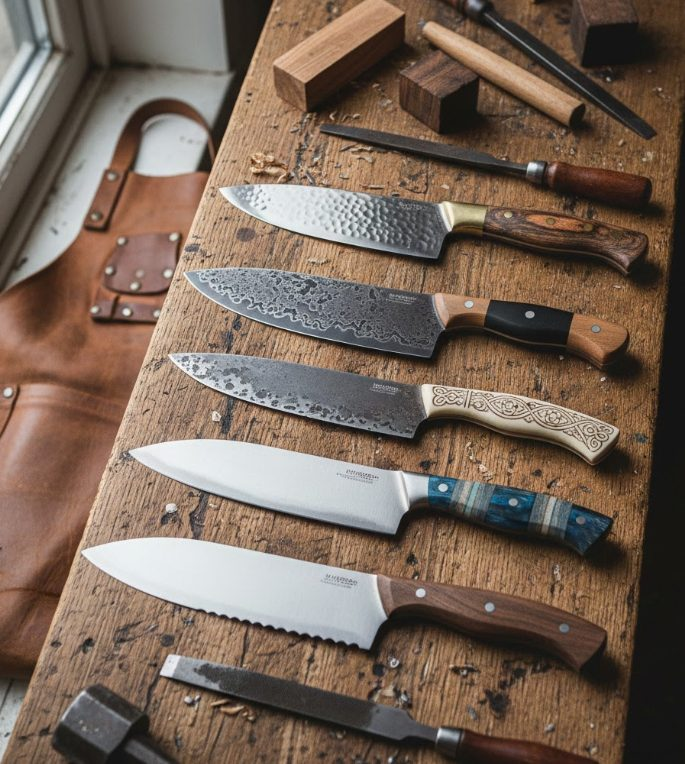
Let’s be honest: most knives don’t suddenly become dull overnight. They slowly stop doing what you expect them to do, while continuing to look perfectly innocent (looking at you, mystery drawer knife).
At first, your knife hesitates on onions. Then it crushes tomatoes instead of slicing them. Eventually, you’re pressing harder, adjusting angles, and blaming the food (which is unfair, because the tomato did nothing wrong).
So let’s talk about what’s really going on at the edge of your knife — without turning this into a physics lecture (or a motivational speech).
What “Sharp” Actually Means (Spoiler: It’s Geometry)
A knife isn’t sharp because it wants to be. It’s sharp because the edge is shaped correctly. Shaping that edge is how to sharpen a knife.
Under a microscope, a knife edge looks like two planes of steel meeting at a very thin line. When that line is clean and narrow, the knife slices easily. When it’s rolled, flattened, or chipped, the knife stops cooperating.
None of this is dramatic. It’s just physics doing what physics does.
Sharpening a knife works by removing a small amount of metal to recreate that clean edge. You’re not “bringing the sharpness back” — you’re reshaping the steel into what it was supposed to be all along (Josh will happily explain this at length if you let him).
This is also where blade quality comes in. A well-designed knife, with good steel and proper heat treatment, sharpens more easily and holds its edge longer. This is not an accident. This is Josh thinking very hard about steel (again).
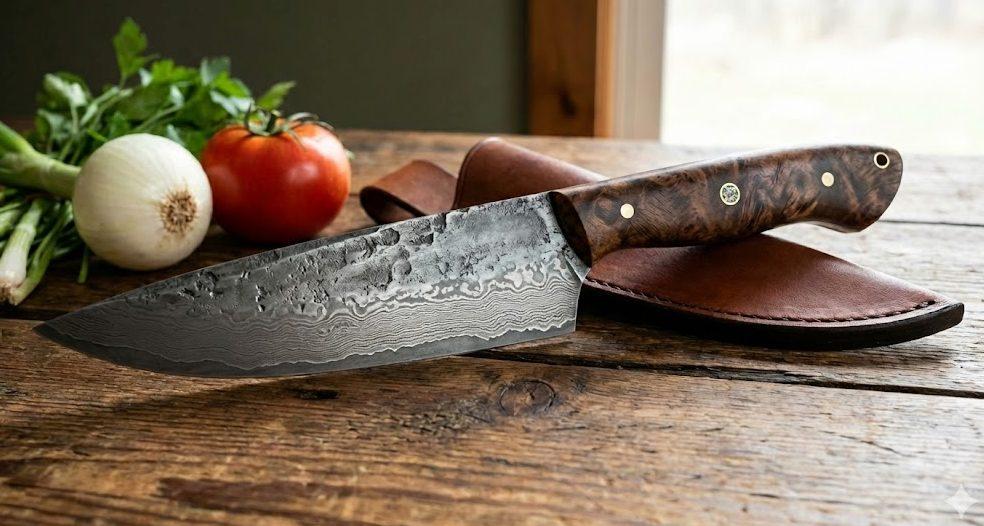
How Does a Knife Sharpener Work?
Every knife sharpener — from a simple pull-through tool to a fancy stone — relies on two things:
- Abrasive material (harder than steel)
- A consistent angle (Josh has opinions about angles)
When steel meets abrasive, microscopic particles of metal are removed. Do this carefully, at the right angle, and the edge becomes thin and sharp again. Do it poorly, and you still remove metal — just not in a helpful way.
Different sharpeners simply control these two factors differently. Some guide the angle for you. Some ask you to do the work yourself. Some hum loudly while doing it (emotionally neutral, but noticeable).
Pull-Through Knife Sharpeners: The Gateway Option
Pull-through sharpeners are popular because they’re easy. You pull the knife through a slot, repeat a few times, and suddenly your knife remembers its job.
Most pull-through sharpeners have stages:
- A coarse stage to reshape a dull edge
- A fine stage to smooth things out
The angle is built in, which makes them beginner-friendly and hard to mess up (unless you really commit to being screwy).
To sharpen a knife for everyday kitchen use, they work well. And knives with good geometry sharpen especially cleanly in these systems — which is why a properly made blade will usually outperform a factory knife here without much effort (Josh calls this “geometry doing the heavy lifting”).
Whetstones: Where Things Get Quiet and Focused
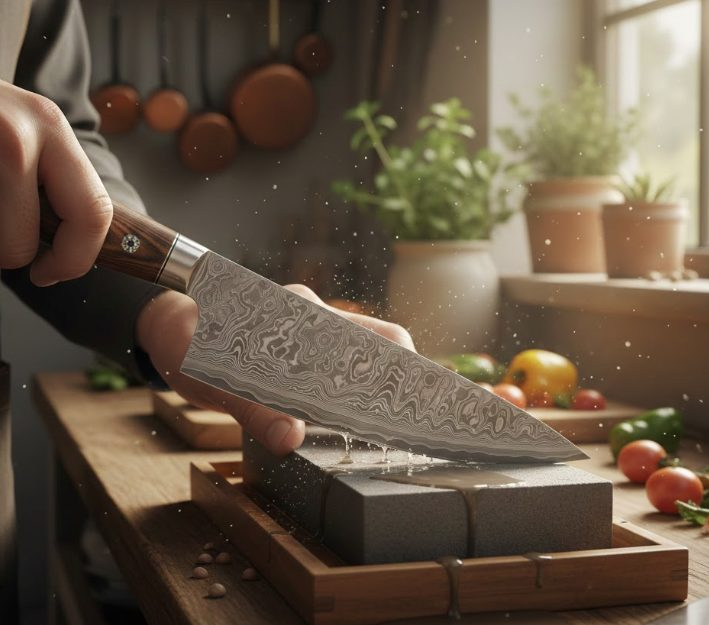
Whetstones are the traditional way to sharpen a knife, and they require you to control the sharpening angle yourself. Typically that’s around 15–20 degrees per side, depending on the knife.
This method:
- Takes practice
- Rewards patience
- Encourages Josh to say things like “listen to the stone”
Coarse stones reshape the edge. Finer stones polish it. With good steel, the process is predictable and deeply satisfying. With bad steel, it’s… character building.
Handmade knives — especially ones designed by someone who sharpens knives professionally (Josh, again) — are meant to work well on stones. They form a burr evenly, respond clearly to grit changes, and don’t fight you the whole time. The edge geometry supports repeated sharpening without becoming fragile or awkward over time.
(Josh cares a lot about this. Possibly too much. But the results are good.)
Electric Knife Sharpeners (Fast, Loud, Effective)
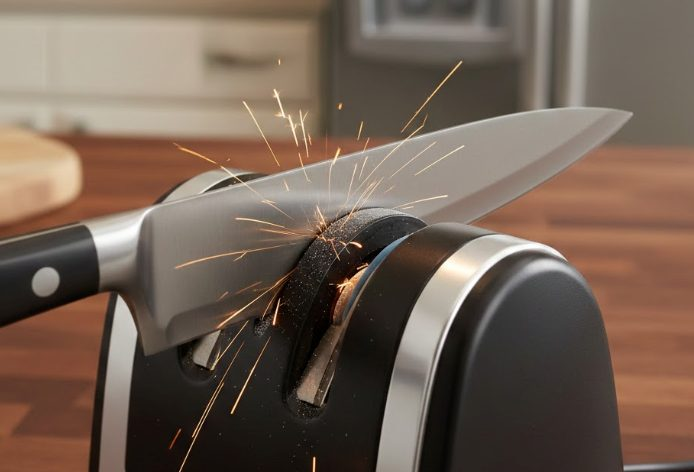
Electric sharpeners use motorized abrasive wheels to do the work for you. There is no need to learn how to sharpen a knife in some complicated way. You pull the blade through guided slots and let the machine handle pressure and angle consistency.
They’re efficient and convenient. As always, better steel means better results — cleaner edges, less material removed, and fewer regrets later.
Electric sharpeners are especially useful if:
- You sharpen multiple knives regularly
- You want consistent results quickly
- You don’t feel like thinking about angles today
As with every other sharpening method, blade quality still matters. Better steel sharpens more cleanly, requires less material removal, and produces a longer-lasting edge.
Josh does not hate electric sharpeners. He just believes they should “know their place.” (We did not ask him to clarify.)
Honing vs. Sharpening (Yes, They’re Different)
This confusion refuses to die, so let’s address it clearly.
- Honing realigns the edge
- Sharpening removes metal
A honing rod straightens an edge that has bent slightly during use. It doesn’t make a dull knife sharp — it makes a slightly dull knife behave like itself again.
Sharpening, on the other hand, creates a new edge.
If you hone regularly, you won’t need to sharpen as often. This is especially true for well-made knives that respond well to alignment and don’t lose their geometry as quickly. (Josh has definitely tested this more than necessary).
Luckily, we teach you how to sharpen a knife and how to hone a knife right here.
Honing and sharpening solve different problems, so they use different tools — and knowing which one you need saves time, steel, and frustration.
Sharpening: Creating a New Edge
Tools: Pull-through sharpener, whetstones, or electric sharpener
Sharpening removes steel to rebuild the edge, so it’s done less often than honing.
How to sharpen a knife (general method):
- Pull-through sharpener: Place the sharpener on a stable surface and pull the knife through each stage from heel to tip, using steady, moderate pressure. Follow the order of stages (coarse to fine).
- Whetstones: Start with a coarse grit if the knife is dull. Maintain a consistent 15–20° angle and slide the blade across the stone until a burr forms, then repeat on the other side. Finish on a finer grit to refine the edge.
- Electric sharpener: Slowly draw the blade through the guided slots, letting the machine do the work. Avoid rushing — speed doesn’t help here.
So basically everything we went over before.
Be sure to test the knife after sharpening (the fun part). If the knife can slice paper cleanly or glide through a tomato without pressure, the edge is rebuilt.
Honing: Realigning the Edge
Tools: Honing rod (steel, ceramic, or diamond-coated)
Honing doesn’t remove much metal. It straightens an edge that’s slightly bent from regular use, which is why it’s best done often.
How to hone a knife:
- Hold the honing rod vertically with the tip resting on a cutting board (this is safer and quieter than the chef-on-TV method).
- Place the heel of the knife against the rod at about a 15–20° angle.
- Draw the knife down and across the rod, moving from heel to tip.
- Repeat 5–8 times per side, using light pressure.
If honing helps the knife cut cleanly again, you’re done. If it doesn’t, the edge needs more than alignment.
Which One Should You Do?
- Hone regularly (every few uses) to keep the edge aligned
- Sharpen occasionally when honing no longer helps
If you’re unsure, hone first. If that doesn’t fix it, sharpen. That’s the entire decision tree.
Think of honing as maintenance, and sharpening as repair. Both matter. They just do different jobs.
When Should You Sharpen a Knife?
If your knife:
- Slides off tomato skins
- Smashes herbs instead of slicing them
- Can’t cut paper without negotiation
…it’s time.
A sharp knife starts a cut effortlessly. And no, pressing harder is not a solution (it is, however, a great way to make things less safe) No amount of force will fix it (Josh will say “it’s geometry” and be correct).
Why Some Knives Sharpen Better Than Others
If you’ve ever sharpened one knife and thought “wow, that was easy,” then sharpened another and thought “am I doing something wrong?” — you’re not alone. That’s just how it works.
Some knives sharpen easily. Some don’t. This is not your fault.
Steel type, heat treatment, and edge geometry all affect:
- How easy it is to sharpen a knife
- How sharp it can get
- How long it stays sharp
This is one of the biggest differences people notice when they switch from mass-produced knives to handmade or small-batch blades. The sharpening process itself becomes easier and more predictable.
A knife designed by someone who cares deeply about sharpening (and has strong feelings about burr formation) will behave better on stones, rods, and sharpeners alike.
JS Sharpening & Bladeworks builds knives with this full lifecycle in mind — sharp out of the box, easy to maintain, and meant to last. This is not accidental. This is Josh refusing to cut corners (literally).
The Best Way to Sharpen a Knife Is the One You’ll Actually Use
There is no single best way of sharpening a knife. There is only the method you’ll realistically stick with.
Pull-through sharpeners are quick and accessible.
Whetstones offer precision and control.
Electric sharpeners provide speed and consistency.
They all work if you understand how a knife sharpener works and respect what it’s doing to the steel.
Combine good technique with a well-made blade, and sharpening stops being a chore. It becomes routine. Maybe even satisfying.
And when your knife glides cleanly through food again — without pressure, without frustration — you’ll remember why sharp tools matter in the first place.
(And somewhere, someone who made that knife is quietly pleased.)
Final Thoughts (Josh Has Many)
The best way to sharpen a knife is the method you’ll actually use. Pull-through sharpener. Whetstone. Electric system. They all work if you understand how a knife sharpener works and don’t fight the process.
Understanding how a knife sharpener works makes the process far less mysterious. Every sharpener relies on abrasive materials and a consistent angle to remove tiny amounts of steel and recreate a clean edge. Pull-through sharpeners simplify the process, whetstones offer hands-on control, and electric sharpeners provide fast, consistent results. While each method works differently, they all benefit from knives that are well-designed, evenly ground, and properly heat-treated.
Knife quality plays a quiet but important role in sharpening. Well-made blades sharpen more easily, respond better to honing, and hold their edge longer, making maintenance less frustrating and more predictable. When good technique meets a thoughtfully crafted knife, sharpening becomes routine rather than a chore — and cutting food stops feeling like a negotiation. It becomes routine. Maybe even enjoyable.
Now you know how to sharpen a knife. And if you ever have questions, Josh would love to explain them (possibly with a diagram).